







3D Level Measurement for Better Bulk Material Handling
The cost of storing materials—along with related salaries, transportation, handling, taxes, insurance, depreciation, and shrinkage—could add up to 10-30% of total inventory costs, according to Investopedia.
For example, one major manufacturer stores and uses alumina. Their carrying costs are $1.50 per year per 100 pounds. They consume 8 million pounds, which equates to $120,000 per year in carrying costs. The manufacturer constantly monitors inventory levels to ensure funds are not tied up in inventory while ensuring production continues.
Reducing carrying costs can boost profits. Managers may base inventory on the economic situation: for instance, when the currency depreciates or purchasing power decreases. Proper inventory handling can reduce the cost of storing products. An understanding of quantity and timeline might also open opportunities for long-term agreements with suppliers.
Safety for People and Production
For plant personnel, automatic inventory measurement systems by BinMaster have been a game changer. Personnel no longer need to climb silos, making them safer and more efficient. Consistent, automatic measurements help maintain safety stock to mitigate stockouts.
It Starts with Measurement, Sensor Selection
For organizations forming a management system focused on maintaining lean inventories, an automated inventory sensor system is a must. BinMaster sensors measure materials in bins, tanks, and silos. The trick is to pick sensors appropriate for your bulk material: grains, powder, aggregate, etc.
Some materials—like powders and solids—form irregular topography in storage silos. Thus, a single measurement point may not be enough data to calculate accurate volume estimates. Putting a single-point sensor in that silo might measure a hill or valley of the surface, making measurements inaccurate.
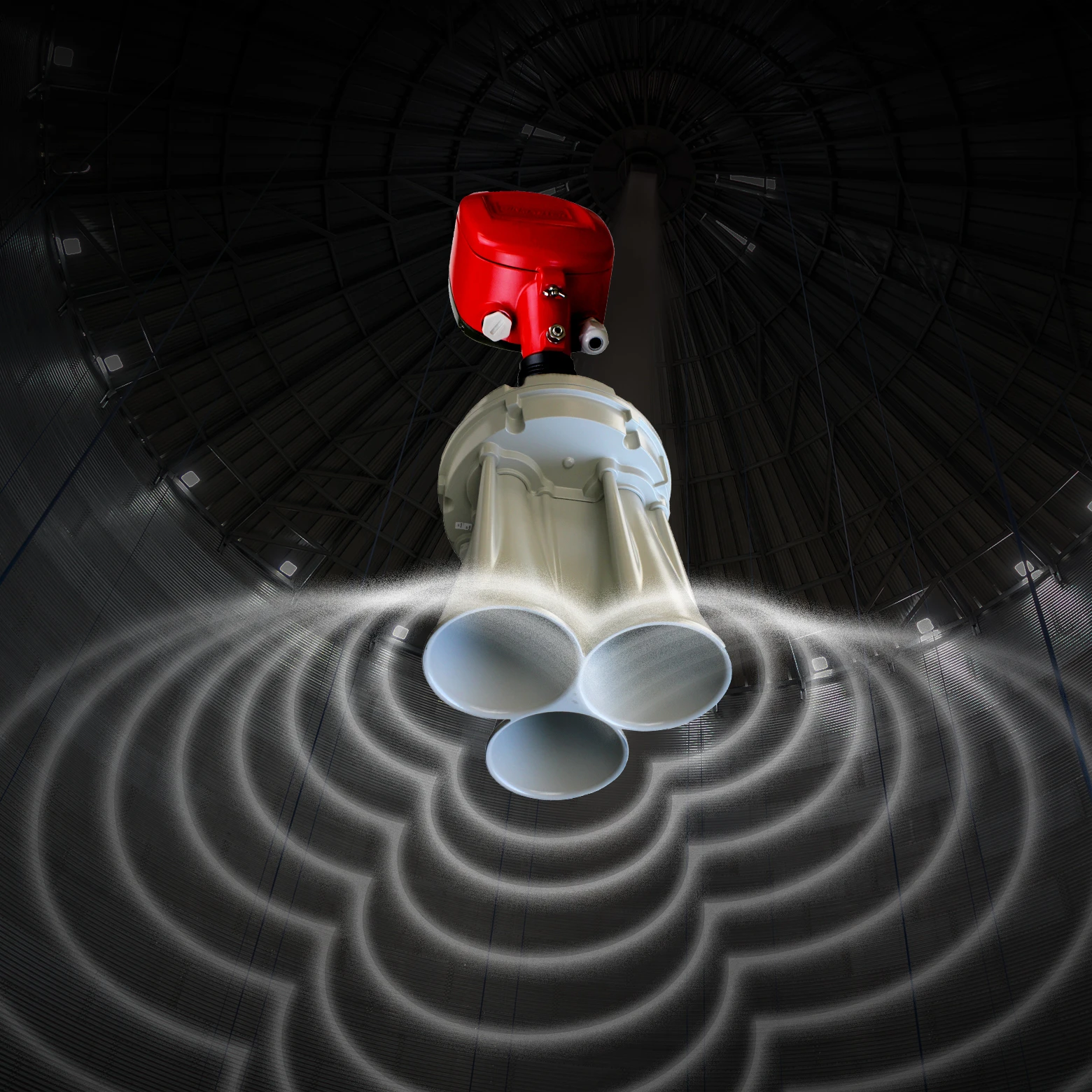
3DLevelScanners account for uneven materials. Also called the 3DSolidsScanner, its acoustic technology scans the material surface and takes multiple measurements to account for high and low spots in the silo. Scanning the surface reveals conditions—such as cone up or cone down—as well as detecting sidewall buildup.
Data from multiple points of measurement are processed using advanced firmware and algorithms, which result in a highly accurate volume measurement.
If a bin is very large in diameter, two or more scanners can be combined into a system to synchronize measurements with high accuracy. Multiple scanners can be added until their 70° beam angle covers the entire surface. Storage domes and large bunkers are good candidates for multi-scanner systems.
Challenge of Heavy Dust
Many solids produce dust, which can be a challenge for level sensors. The 3DLevelScanner operates at very low frequencies, eliminating dust as a barrier to measurement. It performs consistently regardless of conditions within the vessel.
3D acoustic technology works well for alumina powder, carbon black, detergents, polyethylene powder, silica granules, fly ash, and talc powder. The scanner's acoustic pulses helps keep the inside of the scanner transducers clean in such environments, which is important, as a clean sensor will be more reliable and accurate.
Overcoming Clingy Materials
Dusty material stored in silos might require a sensor with a Teflon coating to resist “sticky” situations.
Teflon is recommended when the sensor is measuring clingy materials like flour, calcium carbonate, soda ash, potash, lime, salt, sugar, cocoa, concrete, detergent, or cement.
Non-Contact Sensors Prevent Contamination
Acoustic sensors do not make direct contact with materials, making it safe for powders, granules, or other solids of all types. There’s no risk of getting equipment stuck in deep material as there can be with plumb bob-style sensors.
These scanners will not detach or fall into your silo or bin. Eliminating contact with the material helps ensure a sensor's long life with minimal maintenance or service costs.
Level and Volume Measurement
The accuracy of a 3DLevelScanner is driven by the size of the vessel, the presence or absence of a structure inside it, and the material being measured. The device needs to have a clear view of the material surface. Multiple 3D system configurations are available:
Short for “Reliable Level”
Measures material in a narrow beam directly below the device
Penetrates high levels of dust, performing where other types of level sensors become unreliable or inaccurate
Typically, this model is used with materials less prone to buildup and in narrow or smaller silos
Determines volume based upon an average level in the bin from multiple measurements taken within a 30° beam angle
Often used in narrow silos with diameters up to 16 ft. and heights up to 200 ft.
Can also be used in wider silos, but with diminished accuracy, as the 30° beam angle may not cover the entire material surface
Measures from a broader 70° beam angle, making it appropriate for larger diameter silos with uneven material topography
Reports the lowest, highest, and average distances based on multiple measurements
Provides a very high level of volume accuracy from between one and three percent.
Top of the line; does everything the M Model does, plus adds a unique visualization feature
Uses complex algorithms and processing power to generate a 3D image that indicates where the high and low spots are in the silo
Interactive imaging also shows if the cone is up or down and displays potential sidewall buildup
Used to help manage filling and emptying points or detect if maintenance is needed to clean out buildup
Often used in large silos, in flour‐like powders, and in other types of materials that tend to pile unevenly